The Full-Face Gua Sha Routine: Order, Angles and Pressure
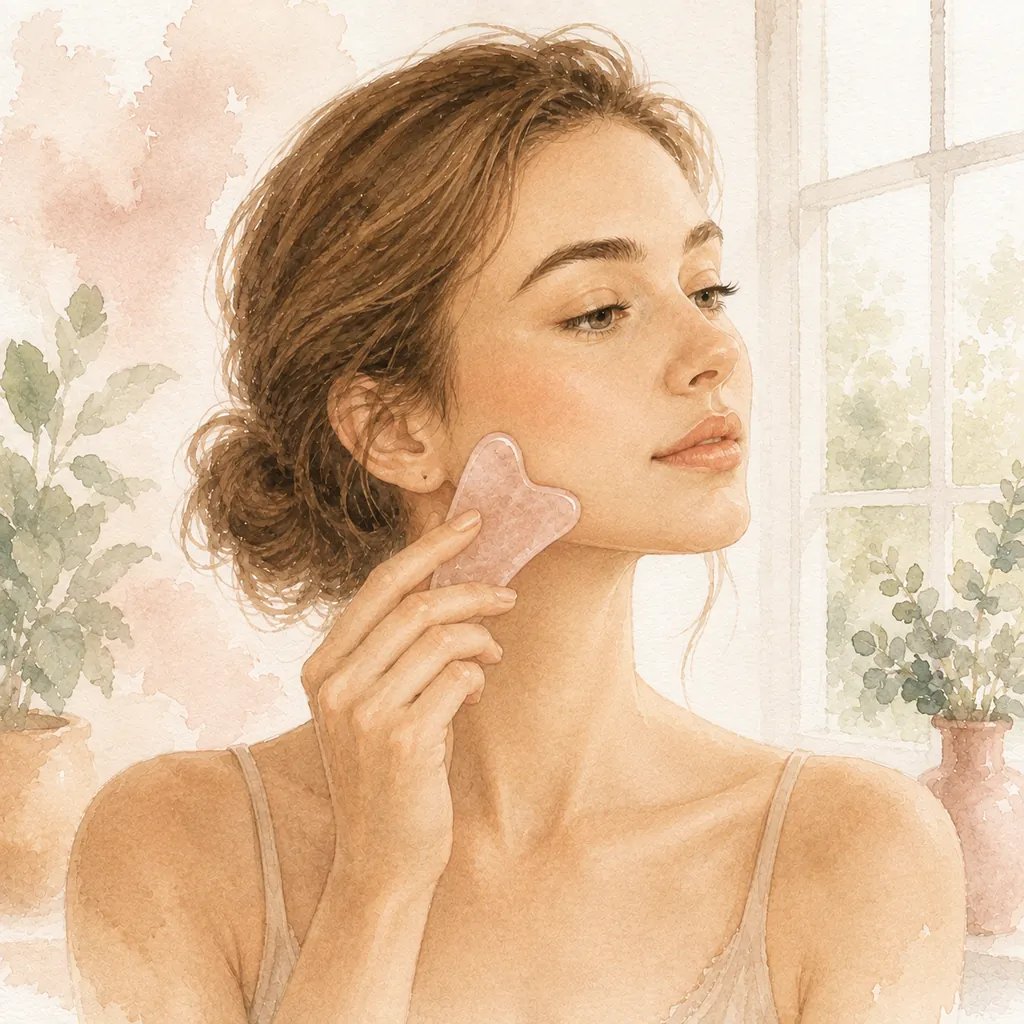
The Full-Face Gua Sha Routine: Order, Angles and Pressure
Most gua sha advice starts with the stone. It's the least important part.
What decides whether five minutes of this does anything is direction, angle and pressure, in that order. A twelve-euro stone used correctly does more than an expensive one used the wrong way, and the wrong way is mostly a matter of sweeping toward the middle of the face instead of away from it.
Here's the full-face routine, in the order it should happen.
Direction matters more than the tool
Everything you're moving drains toward the collarbone. Not up the face, not toward the nose, out toward the ears and then down the neck.
The map is simple enough to memorise in one reading:
Forehead to temples. Cheeks to ears. Jaw from chin toward the ear. Everything down the neck, ending at the collarbone.
That's it. Every stroke below is a variation on those four lines. Get the direction right and the tool matters far less than people think; get it wrong and you're pushing fluid into a place with nowhere to go.
One consequence people miss: you finish at the neck, but you also start there. Clearing the path down before you move anything toward it is the difference between a routine that works and one that just feels nice.
Angle and pressure
Hold the stone almost flat, around 15 to 30 degrees against the skin. Steeper than that and you're using the edge, which is for tension and knots, not for drainage.
Light pressure. Enough to move skin, not enough to drag it. If the skin ahead of the stone is bunching, you're pressing too hard. If it's leaving red streaks, you're pressing much too hard, that's a technique problem, not a detox sign.
Always with oil. A few drops of facial oil, or a slip-heavy serum. Never on dry skin. Dry gua sha is the single most common cause of the irritation people blame on the stone.
Slow. Three to five passes per stroke, unhurried. The whole routine is five minutes, and rushing it is how the angle steepens without you noticing.
The routine, in order
1. Open the neck
Start here. Stone flat, from just under the jaw down the side of the neck to the collarbone, both sides. Three to five passes each. Light.
This is the drain. Everything after this is moving things toward it.
2. Jawline, chin toward ear
The stone's curve sits along the jawbone. Sweep from the centre of the chin, along and slightly above the jawbone, finishing at the earlobe. Three to five passes per side, then close each set with one stroke down the neck.
This is the stroke people come for, and it's also where the most force gets applied. Resist it, the jaw responds to repetition, not pressure.
3. Cheeks, centre toward the ear
From beside the nostril, out across the cheek toward the top of the ear. Then a second, lower line from the corner of the mouth toward the mid-ear. Three to five passes each.
Support the skin with your free hand just ahead of the stone. It stops the dragging that thin cheek skin doesn't tolerate.
4. Under the eyes, the gentlest pass
The smallest edge of the stone, the lightest touch you can manage, from the inner corner out toward the temple. Two or three passes, no more.
The skin here is the thinnest on your body. If you're new to gua sha, skip this zone for the first month and come back to it once your hand has learned what light pressure actually feels like.
5. Forehead, centre toward temples
From the middle of the forehead outward toward each temple, then a short pass upward from between the brows toward the hairline. Three to five passes.
This is the area where tension shows up as much as fluid, so it's the one place a slightly firmer touch is reasonable, still flat, still slow.
6. Close down the neck
Finish where you started. Both sides, from under the jaw down to the collarbone, five passes. This is what carries everything you've just moved out of the face.
Skipping the close is like sweeping a floor and leaving the pile in the middle of the room.
How often
Daily beats weekly. Five minutes most days outperforms one long session on a Sunday, and it isn't close.
The reason is that the two effects have different timelines. De-puffing is immediate and temporary, you'll see it within minutes and it's largely gone within a day. Definition is cumulative and slow, appearing over four to eight weeks of regular practice. A weekly session gets you the first effect once and never accumulates enough of the second.
Five minutes, most evenings, is the honest prescription.
Where the jawline routine fits
If your concern is specifically the lower face, there's a longer, more detailed version of section 2, stroke by stroke, with more passes and a different closing sequence.
Use the full-face routine as your default and the jawline version on the nights when the lower face is what you're actually working on. They're not alternatives; one is the whole floor and the other is one room.
Gua sha and face taping in the same evening
They combine well, in one order only:
Gua sha first, on oiled skin. Then cleanse the oil off completely and give the skin five minutes to dry. Then tape, on clean, dry skin, nothing underneath.
Never the reverse, and never tape over oil, it's the one thing the adhesive will never grip. Your moisturiser goes on in the morning, after the tape comes off. The sequence makes sense mechanically too: you're moving fluid out first, then supporting the tissue at rest for the night.
FAQ
Does the material of the stone matter? Barely. Jade and rose quartz feel different and hold temperature differently; neither changes the outcome. A smooth edge and a shape that fits your jaw matter more than the mineral.
Should I see redness? No. Light flushing that fades in minutes is normal. Streaks or lasting redness mean too much pressure or not enough oil, on the face, marking is a mistake, not a goal.
Morning or evening? Evening if you're combining with taping. Morning if de-puffing is the main thing you want, since that effect is immediate.
Can I use it on broken skin or during a flare? No. Skip active breakouts, an eczema or rosacea flare, and any broken skin entirely.
How long until I see definition? Four to eight weeks of regular practice. The de-puffing you'll see the first evening, don't mistake it for the other thing.