The 30-Day Face Taping Plan, Week by Week
The 30-Day Face Taping Plan, Week by Week
Most people who quit face taping quit in week one, and almost always for the same reason: they started with four placements, every night, and their skin objected before anything had a chance to work.
This plan is built the other way round. It starts smaller than you think is worthwhile and adds one thing at a time. Thirty nights, five minutes each, and a realistic chance of still doing it in February.
Before you start: the tolerance test
One small piece of tape on the jawline, left for 30 minutes. Remove it the way you'd remove a real one, warm water or a little oil, slowly, and look at the skin an hour later, not immediately.
Nothing, or the faintest pink that's gone within the hour, is a pass. Itching, bumps, or redness still visible after a few hours is a stop.
It costs you half an hour. It's the difference between a gentle routine and a week spent undoing a reaction.
You'll also need: a roll of face-specific tape and small scissors. That's the entire list. One roll lasts months.
Night one: a single strip
Not a routine. One strip.
Cleanse with a gentle gel or foam, no oils, no balms, and wait five minutes until the skin is completely dry. Cut a piece around 8–12 cm, round the corners, and place it along the jawline: from just under the chin, along and slightly above the jawbone, finishing near the earlobe.
Let your face go completely slack before you lay it down, and lay it down, don't stretch it. Then sleep.
The jawline is the recommended first placement for three reasons: it's the easiest to get right, it's the least sensitive skin on the face, and the lower face gives the clearest early feedback. If you sleep on your side, it's also the placement you'll get the most from, side-sleeping presses the lower face out of line for six to eight hours a night.
In the morning: warm water in the shower, slow removal, then your serum and a light moisturiser. That's the slot they belong in.
Week 1, nightly, one zone
The same single jawline strip, every night. Nothing added.
That's the whole assignment, and the restraint is the point. You're not testing whether face taping works, you're testing whether your skin is comfortable with it, and one zone tells you that far more clearly than four would.
What to notice: how your skin looks an hour after removal, not immediately. And whether the strip was still fully attached in the morning. If it lifted, the cause is almost always product underneath, damp skin, or square corners.
If anything looks irritated, skip a night. That's the one reason to.
Week 2, add the drainage, keep the zone
Still the jawline. Every night. But now two to three minutes of lymphatic drainage before you tape, and from here on it's the first step of the routine, not an optional extra.
Start at the neck: gentle movements downward, activating the nodes where lymph drains. Then from the centre of the face outward, forehead to temples, under the cheeks, under the chin. Always out and down. Pressure light as a feather; lymph vessels sit just under the surface and firm pressure closes them rather than opening them.
This is the step most people skip, and it's the one that stops results plateauing. A lifting strip on a face that's holding fluid holds the fluid in place. Move it first, then support it.
What to notice: mornings should start feeling different before they start looking different. That's normal and it's the right order.
Week 3, same zone, add the release exercise
Still one zone. Two full weeks on it is the minimum, and you're only just reaching that now.
What changes this week is what happens before the tape: one minute of conscious release for the muscle you're about to tape. The tape holds whatever you set it to, so set it relaxed.
If your first zone has settled and you genuinely want to add a second, these are the options:
Lines that show up in the same place every year, forehead (two or three horizontal strips) or the elevens (one short strip cut into a narrow V) Smile lines, two short angled strips, from beside the nostril up toward the cheekbone, lifting the cheek gently with your other hand first A face that wakes up swollen, the fan cut, anchored near the ear or collarbone with the tails laid out toward the drainage direction
One second zone at most, and only after two solid weeks on the first.
What to notice: this is roughly where the first change you'd notice yourself tends to appear, around ten days of consistent taping. Don't go looking for it every morning.
Week 4, your own rhythm
Daily, one or two placements, and from here it's maintenance rather than a plan.
Consistency is the base, not intensity. That's the whole principle and it doesn't change after day thirty. Overnight, six to eight hours, for static lines. Two to four hours in the day if what you're working on is a dynamic line, the forehead, the frown, though not right before something where you'll be gesturing a lot.
A realistic full night at this stage: drainage, a release exercise, and one or two strips. About six minutes, before bed.
What to track, and what to ignore
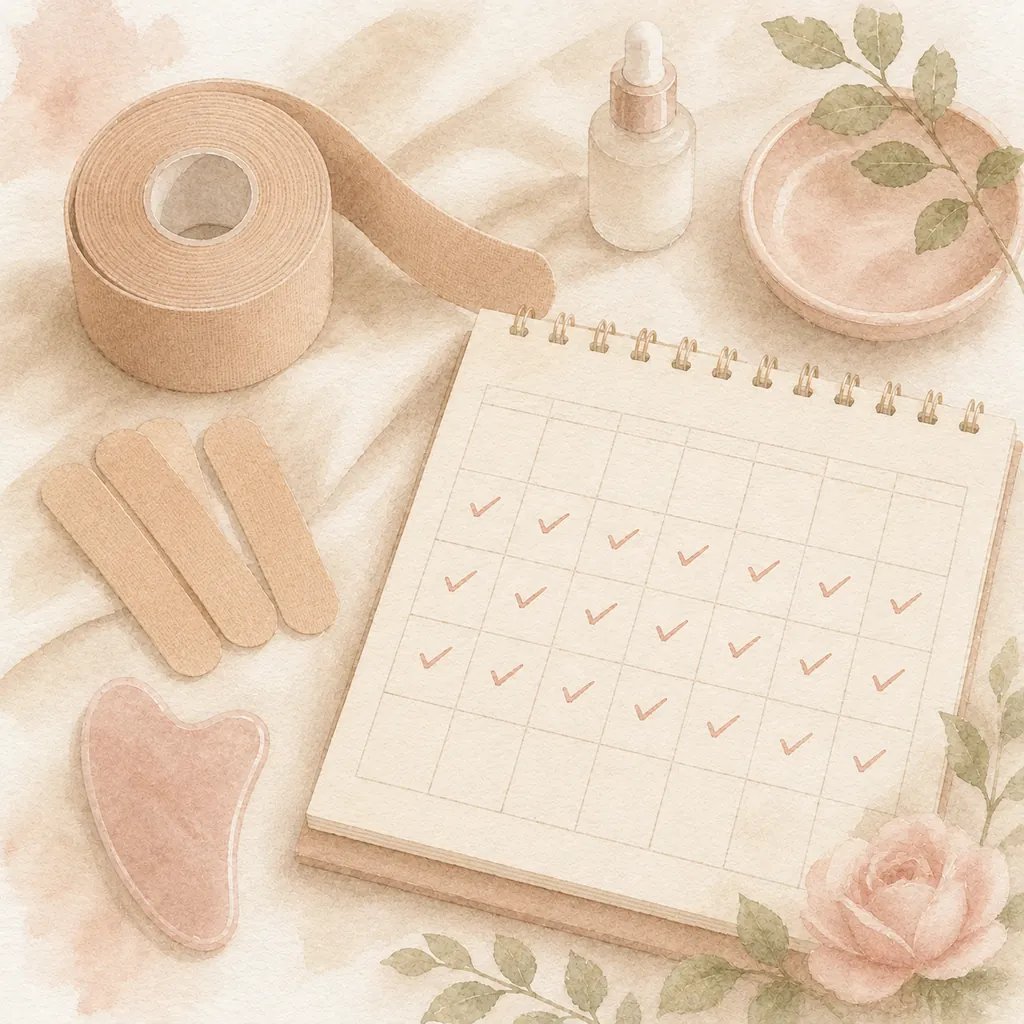
Track: the nights you did it. That's it. A mark on a calendar or in an app, nothing more elaborate, because the only variable that reliably predicts whether this works is consistency.
Also worth noting once a week: how your face feels on waking. Heavy, neutral, or light. It's subjective and it's still the earliest signal you'll get.
Ignore: daily mirror checks. Nothing changes overnight, and the checking itself is what makes people quit, a month of finding nothing feels like failure even when the month was working.
Ignore: photographing your face every day. Lighting varies more than your face does over thirty days. If you want a comparison, take one photo on night one and one on night thirty, same window, same time of day.
After 30 days
Here's the honest timeline against your month:
Around day ten, the first change you'd notice yourself, usually the lower face, usually in how it looks first thing rather than by evening. Between four and eight weeks, fine lines visibly softer. Deep static furrows slow down; they don't erase, and nothing applied to the surface changes that.
So thirty days puts you inside the window for the first, at the start of the window for the second, and nowhere near the end of the story. If you want a fair verdict, run it to sixty.
And the effect that surprises most people isn't on the list at all: after a few weeks of feeling your forehead held still at night, you start catching yourself frowning at your laptop. That's the change that compounds long after the tape.
FAQ
Can I skip to week three if I've taped before? Start at week two. Even experienced tapers benefit from re-establishing the drainage habit before anything else.
What if I miss a night? Nothing happens. Pick it up the next night. Missing three in a row is worth noticing; missing one isn't worth thinking about.
Can I do this and gua sha? Yes, gua sha in the evening, before the tape goes on, with a little oil. Then cleanse the oil off completely and give the skin five minutes to dry. Oil is the one thing the adhesive will never grip.
How long does one roll last? A five-metre roll, used nightly on one or two placements, lasts most people a couple of months.
Is there a version for very sensitive skin? Yes, shorter sessions, two nights on and two off, one zone only. Reactive skin is the one case where daily isn't the answer. Start there rather than here.